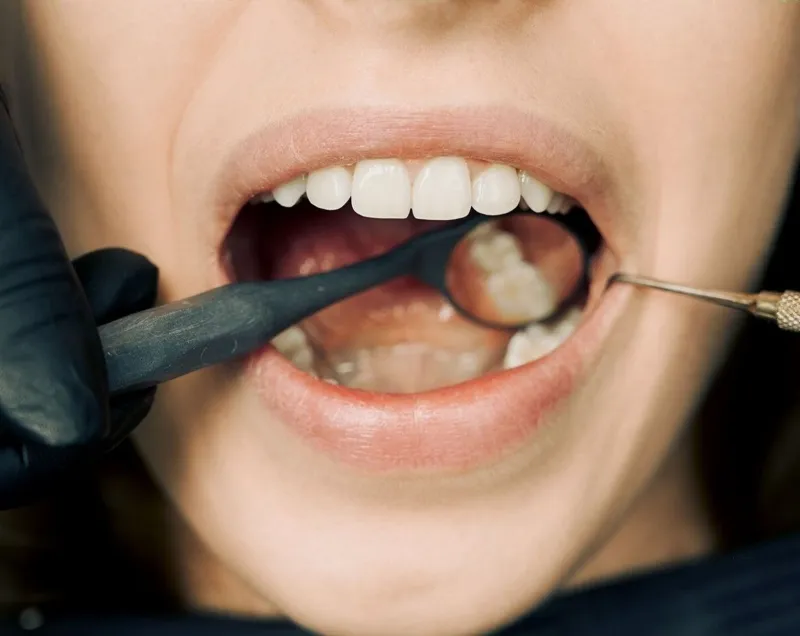
Pink in the Sink Isn't 'Normal' — A Gentle Case for Taking Bleeding Gums Seriously
Photo: Tarre10, CC BY-SA 4.0, via Wikimedia Commons
Somewhere in Britain this morning, someone spat into a sink, saw pink, and thought: that's normal, isn't it.
It is the most understandable mistake in dentistry. Bleeding gums are so common that they have become background noise — the dental equivalent of a creaky stair. Add in a lifetime of adverts showing foamy pink mouths, and it is no wonder people assume a bit of blood is simply what brushing looks like.
But here is the thing I would gently push back on: common and normal are not the same word. And of all the things that can go wrong in a mouth, early gum disease is one of the most treatable — and one of the most ignored.
The shrug has a logic to it
I am not going to pretend this is about laziness. It is not.
People delay for reasons that make complete sense. Cost anxiety, first — nobody wants to ring a practice and find out they have accidentally committed to hundreds of pounds. Access, second: in parts of the UK, finding an NHS dentist with space is genuinely hard work, and rejection on the phone is demoralising enough that many people quietly stop trying. Then there is the third reason, the one people mention less: not wanting to be told off.
That last one deserves taking seriously. Nobody enjoys sitting in a chair while someone lists their failings with an instrument in their hand. If the choice feels like 'ignore it' versus 'be scolded', ignoring it is a perfectly rational response. It is also the one that costs more in the long run.
Why it is worth caring about
Gum disease runs in two broad stages. The first, gingivitis, is inflammation of the gum tissue caused by plaque sitting along the gum line. It makes gums bleed, look puffy and feel tender. Crucially, it is reversible — usually within a couple of weeks of decent cleaning, no surgery required, no drama.
The second, periodontitis, is what happens when the inflammation is left long enough to affect the bone holding the teeth in. That damage does not reverse. It can be managed, often very well, but it cannot be undone. This is the bit many people do not realise: the gap between the reversible stage and the permanent one is measured in months and years, not days. Which means there is almost always time to act — but the clock is quietly running.
There is also a wider picture. Gum disease is strongly associated with diabetes, with cardiovascular disease and with smoking, and it is more common in pregnancy. The direction of cause and effect is not fully settled and it would be over-egging it to say that flossing saves your heart. But it is fair to say that gums are not an isolated little fiefdom — they are part of a body.
The lecture isn't the point
If you take one thing from this piece, make it this: you do not need to be a perfect patient to be seen. You do not need to have flossed, or to have stopped smoking, or to have booked six months ago. Dentists and hygienists see inflamed gums every single day. It is the most ordinary thing in the world in that room.
You are allowed to say, at the start of the appointment: 'I know my gums aren't great and I'd rather have the facts than a telling-off.' Most clinicians will be relieved. What they want is to help you keep your teeth, not to grade your homework.
A realistic first step
If you have been putting this off, skip the grand overhaul. Try a two-week reset instead.
Clean where it bleeds. The instinct is to leave a bleeding area alone. Do the opposite — gently, with a soft brush, angled towards the gum line, for two minutes, twice a day. Do not scrub.
Get between the teeth once a day. Interdental brushes sized to your gaps are usually more effective than floss, and far less fiddly. Ask for a mixed pack and find the size that just fits. A little blood at first is normal and tends to settle within a week or so.
Spit, don't rinse. Rinsing straight after brushing washes away the fluoride you just applied.
Write it down. Note when the bleeding started and whether it is every day or occasional. It is surprisingly useful, and it makes you sound — and feel — less like you are wasting someone's time.
Then make the call. One phone call, in your own words: 'I've had bleeding gums for a few weeks and I'd like a check-up. Do you have any NHS spaces?' If money is the worry, ask which NHS band applies before you book, and ask whether you can see the hygienist directly — many practices now offer that, and it is often quicker and cheaper than a full appointment. If nobody local has space, the NHS website's dentist finder and NHS 111 are worth a go, and it is fine to ask to join a waiting list.
The only real mistake
Bleeding gums are not a personality flaw. They are a small, common, mostly reversible signal — and the single worst thing you can do with one is decide it is normal and carry on.
Pink in the sink is information. Treat it as a nudge rather than a judgement, book the appointment you have been half-planning since about March, and give your gums a fortnight of decent cleaning while you wait. That is not a lecture. It is just a fairly good deal.