When the Waiting Room Is Full: A Calm, Practical Plan for Gum Worries While You Wait
Here's a sentence I'd like to see less often: 'I've been trying to get an NHS dentist for two years.' It comes up constantly — in comments, in conversations, in the queue at the pharmacy. And it's usually followed by a quieter question: what am I supposed to do about my gums in the meantime?
Let me be straight with you. I'm not going to pretend a blog post replaces a dentist. It doesn't. But there's a genuine gap between 'do nothing and worry' and 'get seen tomorrow', and it's possible to occupy that gap sensibly. This is my case for a bit of structured self-management, plus a bit of polite stubbornness.
First, a reality check on what home care can and can't do
Home care is genuinely powerful for prevention and for early, mild gum inflammation. Plaque-induced bleeding in a person with otherwise healthy gums often responds well to a fortnight of thorough cleaning between the teeth. That's not a placebo — it's the same mechanism a hygienist would set you up with.
What home care cannot do is remove hardened calculus, treat established periodontal pockets, drain an abscess, or diagnose anything. If your gums have been receding for years, or a tooth is loose, no amount of interdental brushes is fixing that. Knowing the boundary stops you wasting money and, more importantly, stops you delaying when delay matters.
The at-home basics, done properly
If you do nothing else, do these four things consistently for the next month:
- Brush twice daily with a fluoride toothpaste, two minutes, and don't rinse afterwards — spit, don't swill. That last bit is the one most people get wrong.
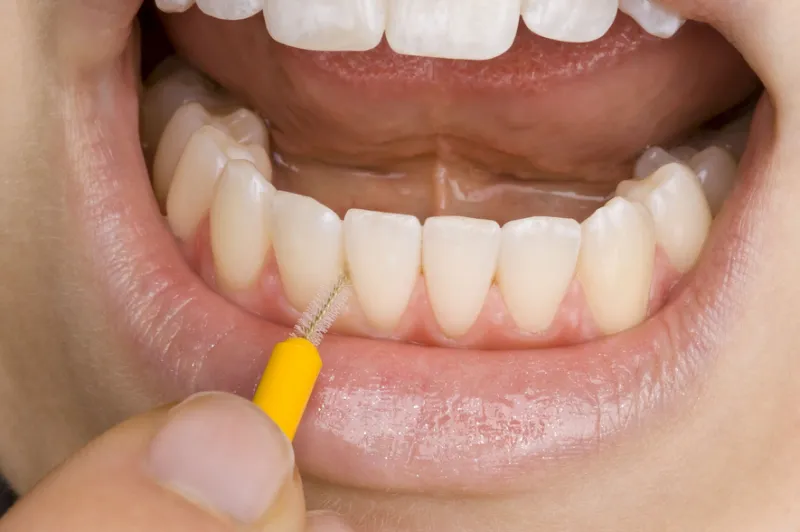
- Clean between the teeth once a day. Interdental brushes if you have gaps, floss if you don't. This is the single highest-value change for gum health, full stop.
- Stop smoking if you smoke. I know. But smoking masks the bleeding that would otherwise tell you something's wrong, and it's the biggest modifiable risk factor for gum disease. Free NHS stop smoking support still exists in most areas.
- Cut the constant snacking and sipping. Grazing on sugary things all day keeps your mouth in a near-permanent acid state. Mealtimes are kinder.
A soft or medium brush, a pea-sized blob of toothpaste, and a bit of patience. That's the whole kit.
Which over-the-counter products are actually worth it
- Chlorhexidine mouthwash (the strong-tasting one): useful for short bursts — a week or so — after a procedure or during a flare-up. Not for long-term use; it stains teeth and stops being helpful. Your dentist will likely say the same.
- A fluoride mouthwash at a different time of day from brushing: cheap and reasonable if you're at higher risk of decay.
- Sensitivity toothpaste: genuinely effective for twinges, and often what's behind 'my gums hurt' when the truth is exposed tooth necks.
- Saltwater rinses: free, soothing, mildly anti-inflammatory. Warm water and a teaspoon of salt, twice a day during a flare. No magic, but no harm either.
- Don't bother with: 'gum detox' oils, charcoal anything, and any product promising to replace a professional clean. Also — and I mean this — do not buy antibiotics online. It's illegal to supply prescription-only medicines that way, and it's a genuinely bad idea.
The things that shouldn't wait
Most gum disease is quiet and slow. That's the annoying thing about it. But some presentations need same-day attention, and those are worth knowing cold:
- Swelling in your face or under your jaw, especially with fever or feeling unwell.
- Swelling that closes your eye, or that's spreading quickly.
- Difficulty swallowing, or any difficulty breathing. Call 999.
- Bleeding that won't stop after ten minutes of firm pressure.
- A knocked-out or badly broken tooth — that's an emergency, and time matters.
For anything urgent but not life-threatening, NHS 111 can direct you to urgent dental care, and most areas have an out-of-hours dental service. You do not need to be registered anywhere to use it.
How to actually get seen
Some practical levers, in rough order of effectiveness:
Say the symptom, not the wish. 'I'd like a check-up at some point' gets you a shrug. 'I have bleeding gums and a loose lower incisor' gets you triaged. Be specific and be honest.
Ask directly about the waiting list and about cancellations. Many practices keep a short-notice list. Being on it costs you nothing.
Use NHS 111 for urgent problems. It's a legitimate route to an urgent appointment when you can't get one any other way.
Try dental schools. Teaching hospitals take patients at reduced cost, supervised by qualified clinicians. Waiting lists exist, but they move.
Check community dental services if you have complex needs, a disability, or severe dental anxiety — most areas run a referral service, sometimes via your GP.
Ask about payment plans and NHS band charges. NHS charges vary across the four nations, and in England a Band 1 appointment is roughly £28 at the time of writing. If cost is the barrier, say so — practices sometimes know about local support schemes.
Keep a short symptom diary. Date, what you noticed, a photo if you can get one. It makes any appointment more useful, and it stops you second-guessing whether things have changed.
Please don't do these
Don't stop brushing a bleeding area — that's the opposite of helpful. Don't attack calculus with a metal file, a scaler from an auction site, or a nail. Don't rinse with hydrogen peroxide from the cupboard. And don't decide that because you can't get an appointment, the problem must not be real.
The takeaway
Being stuck on a waiting list is not the same as being powerless. You can clean between your teeth properly, you can stop smoking, you can spend a tenner wisely rather than fifty badly, and you can be the person who describes a symptom clearly instead of vaguely. And if something changes fast — swelling, fever, trouble swallowing — you can stop waiting and ask for urgent help without apologising for it. That's not panic. That's triage.